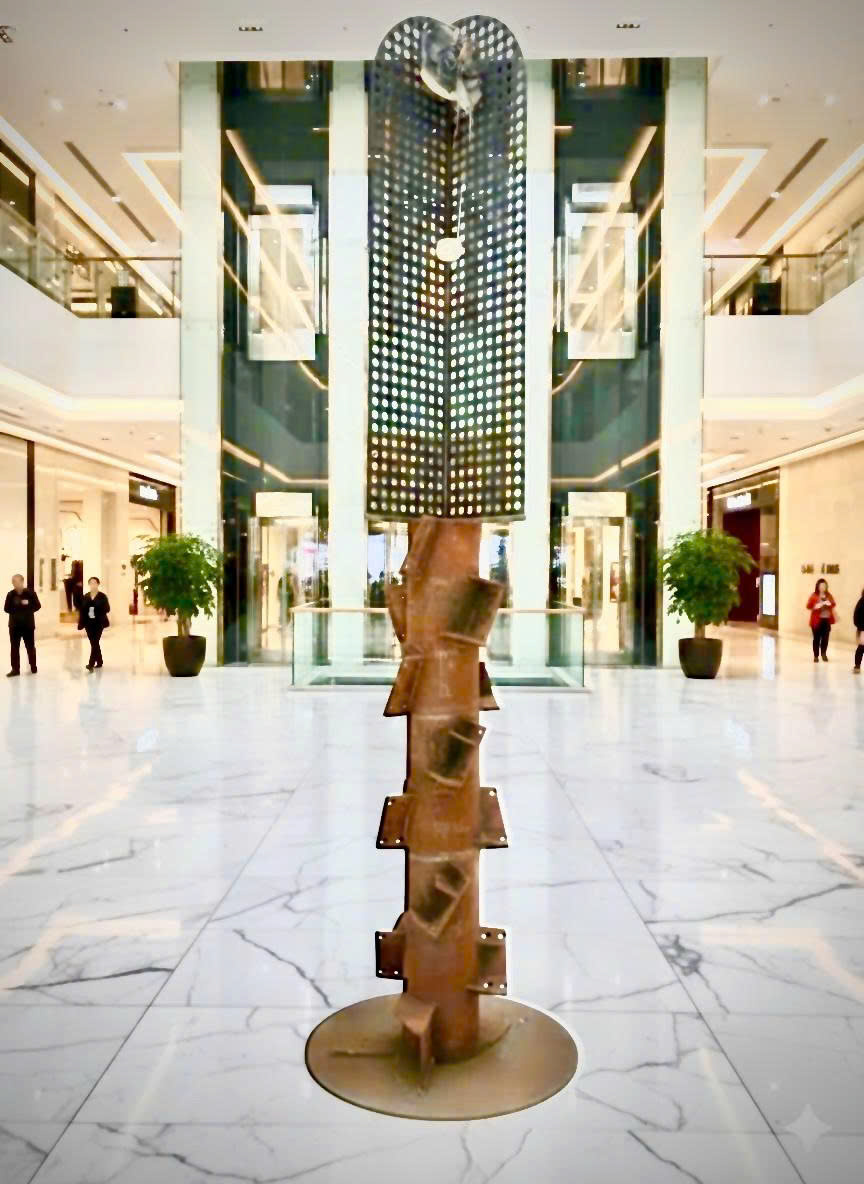
A 5-m tall art work from rejects by the Vietstar Group.
Installed in the main hall of The Student Cultural House at Viet Nam National University Ho Chi Minh City, this work was created by the Vietstar Group for the of Rejoice and Refuse Festival – March 2026. It invites the city’s residents to pause, look up, and read time differently—to feel how love, like time, is moving faster than usual.
The sculpture is composed of two reclaimed industrial elements, reassembled into a vertical totem.
The base column is a discarded tumbling shaft—a core mechanical axis once used in waste-sorting systems. Though rarely noticed, this ingenious component plays a vital role in reducing plastic waste in everyday life. It works quietly to separate organic matter from HDPE and LDPE plastics in household waste from Ho Chi Minh City and neighboring provinces, transforming refuse into recycled plastic pellets and compost. In this work, the shaft stands upright, stripped of motion yet full of memory—an invisible laborer finally brought into view.
Rising above it is the tower clock, constructed from a perforated steel floor grid originally used to separate organic materials in waste-processing lines. Embedded within the grid is a real clock—an object deeply connected to the Vietstar plant since its earliest trial operations, when the first tons of waste were processed. For over fifteen years, this machine operated on the factory floor, hooking, scraping, recycling.
Now, it returns as a clock.
It ticks slightly faster than normal, echoing the rhythm of a grandfather’s clock—a reminder passed down through generations. Time here is no longer neutral. It accelerates, urging reflection: What are we consuming? What are we leaving behind? How much time do we truly have?
By reviving industrial remnants as poetic form, the work collapses the distance between machine and memory, waste and care, labor and love. It stands not as a monument, but as a question—quietly asking its viewers to reconsider their relationship with time, responsibility, and the unseen systems that sustain urban life.